Which US Cities Have the Most Overnight Break-Ins?

Key takeaways

  • Seattle, WA; Cleveland, OH; and Spokane, WA, have the highest overnight residential burglary rates per capita of major cities analyzed, at 234.6, 196.9, and 182.1 per 100,000 residents, respectively.
  • Frisco, TX; Irvine, CA; and Gilbert, AZ, see the lowest rates of residential burglaries between 10 p.m. and 6 a.m., each recording fewer than 8 per 100,000 residents.
  • The top 3 safest states with the fewest overnight home break-ins are New Hampshire, Hawaii, and Vermont.
  • The top 3 most at-risk states for overnight home break-ins are North Dakota, Washington, and New Mexico.
  • Nearly 1 in 10 Americans (7%) don't lock their doors at night.
Woman going to bed.
 

Feeling safe at home is essential, especially at night, when most people expect to fully relax and recharge. This analysis by Vivint combines overnight residential burglary data from the FBI with a survey of 1,000 Americans to better understand how safety varies across the country and how people protect their homes after dark.

By looking at both crime trends and real-life habits, a clearer picture emerges of where risks are higher and what practical steps people are taking to stay secure. For homeowners and renters alike, these insights can help inform smarter nighttime routines.

Mapping state-level break-ins at night

Where you live can shape your overall sense of nighttime security, with some states experiencing higher overnight residential burglary rates than others. In this analysis, overnight refers to incidents that occurred between 10 p.m. and 6 a.m.

North Dakota, Washington, and New Mexico recorded the highest overnight residential burglary rates per capita in 2024, each reporting more than 50 incidents per 100,000 residents. These elevated rates show how regional patterns can influence risk levels.
New Hampshire, Hawaii, and Vermont reported the lowest rates, each with fewer than 10 overnight burglaries per 100,000 residents. These lower rates suggest that some states may offer added peace of mind for residents focused on nighttime safety.

Top 10 Most At-Risk States for Nighttime Break-Ins

  1. North Dakota (63.3)
  2. Washington (61.3)
  3. New Mexico (53.9)
  4. South Carolina (51.6)
  5. Colorado (50.7)
  6. Oklahoma (47.7)
  7. Arkansas (46.5)
  8. Nevada (43.1)
  9. North Carolina (43.0)
  10. Louisiana (42.2)

Bottom 10 Least At-Risk States for Nighttime Break-Ins

  1. New Hampshire (4.9)
  2. Hawaii (8.4)
  3. Vermont (9.1)
  4. Maine (10.2)
  5. Connecticut (12.8)
  6. Pennsylvania (13.3)
  7. Idaho (15.0)
  8. Rhode Island (15.8)
  9. Alaska (15.9)
  10. Arizona (16.1)

Which cities are the safet at night?

Local trends often reveal even more variation, with certain cities standing out for both higher and lower overnight burglary activity. The next part of this analysis examined overnight residential burglary rates across 100 of the most populous U.S. cities.

Seattle, Cleveland, and Spokane reported the highest overnight residential burglary rates per capita of cities analyzed, at 234.6, 196.9, and 182.1 incidents per 100,000 residents, respectively.

Top 10 most at-risk cities for nighttime home break-ins

  1. Seattle, WA (234.6)
  2. Cleveland, OH (196.9)
  3. Spokane, WA (182.1)
  4. Minneapolis, MN (146.9)
  5. Cincinnati, OH (138.4)
  6. Tulsa, OK (137.4)
  7. Las Vegas, NV (135.7)
  8. Memphis, TN (127.3)
  9. Miami, FL (122.6)
  10. Detroit, MI (122.3)

Meanwhile, Frisco, Irvine, and Gilbert recorded the lowest rates, each with fewer than 8 incidents per 100,000 residents between 10 p.m. and 6 a.m.

Bottom 10 least at-risk for nighttime home break-ins

  1. Frisco, TX (5.9)
  2. Irvine, CA (6.5)
  3. Gilbert, AZ (7.5)
  4. Cape Coral, FL (8.4)
  5. Port St. Lucie, FL (8.9)
  6. McKinney, TX (11.7)
  7. Virginia Beach, VA (12.6)
  8. Chandler, AZ (13.5)
  9. Honolulu, HI (16)
  10. Plano, TX (17.2)

Many of the safest cities analyzed were located in Texas, Arizona, and Florida, with 7 of the 10 lowest-risk cities falling in these states. Suburban areas like Frisco, Gilbert, and McKinney consistently reported rates below 15 per 100K residents, suggesting more stable overnight conditions in these communities.

How Americans secure their homes at night

Beyond location, personal habits play a major role in how safe people feel and how well their homes are protected overnight.

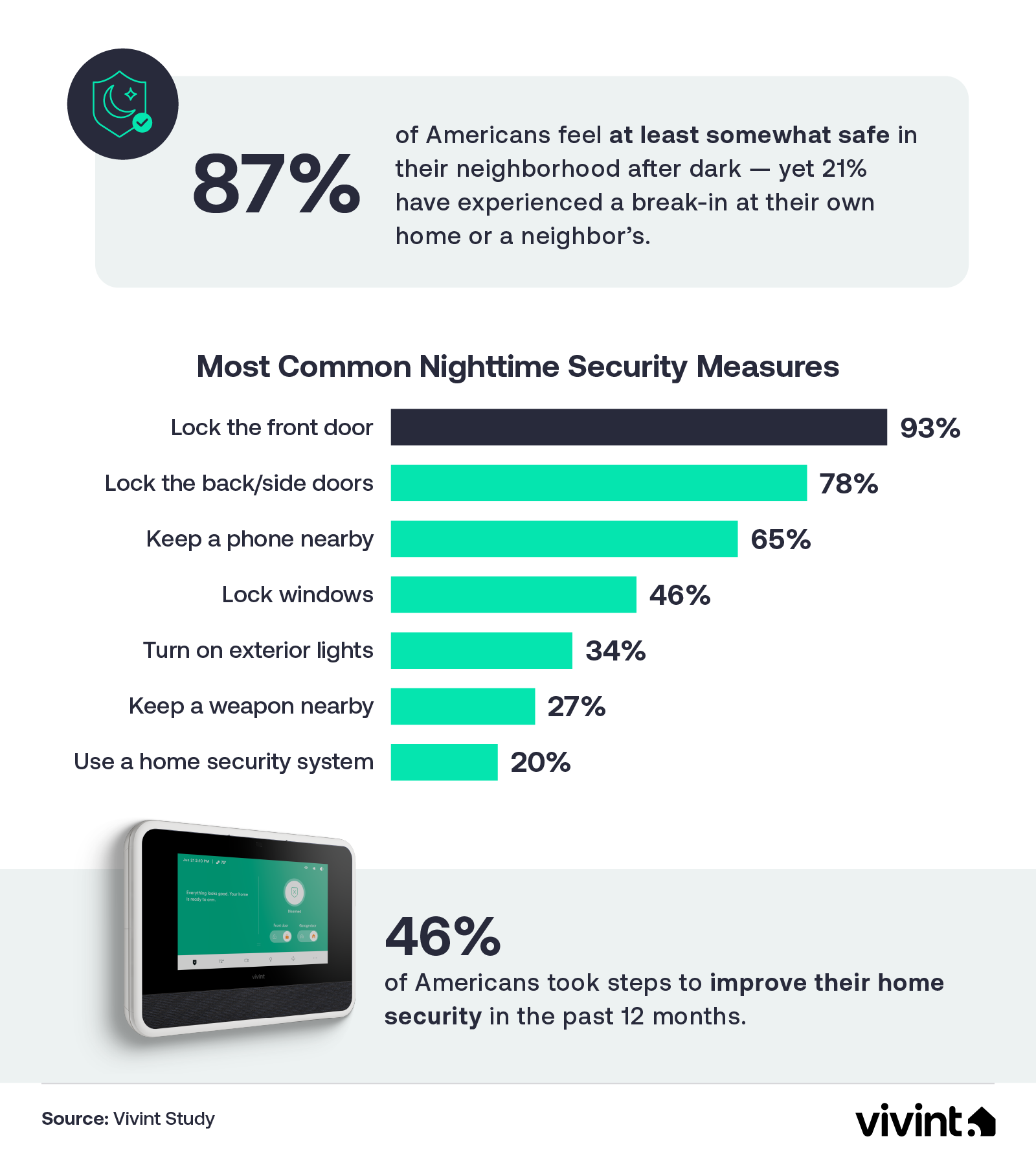
Information about common nighttime security measures.
 

A majority of Americans (87%) reported feeling at least somewhat safe in their neighborhood after dark, including 42% who felt extremely safe. Overall, 84% believe their home is adequately secured at night, though 18% are still worried about a break-in while asleep. Basic precautions were widely adopted, with 93% locking their front door before bed.

While 65% kept a phone nearby for emergencies, more proactive security measures were less common. Only 46% locked their windows, and just 20% activated a home security system or alarm. Some households relied on personal protection: 27% reported keeping a weapon nearby while sleeping, compared with 15% who had a professionally monitored security system.

Encouragingly, 46% of Americans made changes to their home security in the past year, with installing security cameras (23%) and adding exterior lighting (17%) being the most common upgrades. Simple improvements like these can help strengthen nighttime peace of mind.

Building confidence in your nighttime safety routine

Feeling secure at night often comes down to a mix of awareness and consistent habits. While burglary rates varied across states and cities, many Americans already took key precautions, such as locking doors and keeping emergency tools nearby. Building on those habits—by securing windows, improving exterior lighting, or incorporating professionally monitored security systems—can further strengthen that sense of protection.

Modern smart home security solutions, including features like security cameras, motion detection, and real-time alerts, offer a more connected way to stay informed overnight. With integrated systems like those offered by Vivint, homeowners can keep an eye on their property and maintain greater peace of mind, making it easier to settle in for the night and wake up feeling confident in their home's safety.

Let’s be neighbors.

Subscribe to our weekly newsletter for more smart tips.

Methodology

Vivint commissioned an online survey of 1,000 US adults to understand nighttime home security habits and perceptions of neighborhood safety. The survey was conducted in March 2026. Respondents were asked about their bedtime security routines, protective measures kept nearby while sleeping, home security system usage, and any changes made to their home security in the past 12 months.

Overnight residential burglary data was sourced from the FBI's National Incident-Based Reporting System (NIBRS) for the full calendar year 2024. Incidents were filtered to offense code 220 (Burglary/Breaking and Entering), location type 20 (Residence/Home), and incident hours between 10 p.m. and 6 a.m. (hours 22, 23, 0, 1, 2, 3, 4, and 5). Agency-level data was matched to city populations using US Census Bureau population estimates. Rates are expressed as overnight residential burglaries per 100,000 residents. City rankings are limited to 100 of the most populous U.S. cities with populations of 200,000 or greater where primary law enforcement agency data was available in NIBRS, and should not be interpreted as a comprehensive ranking of all U.S. cities.

Limitations: NIBRS participation is voluntary, and not all law enforcement agencies submit complete data. Some major cities do not appear in the 2024 NIBRS dataset and are therefore absent from city rankings. Rankings reflect only jurisdictions with available and complete annual reporting and should not be interpreted as evidence that excluded cities are safer or more dangerous than those included. City rankings are based on reporting agency boundaries, which don't always align perfectly with official city limits. Some agencies cover areas larger or smaller than the city itself, which can affect population denominators and therefore rates.

Fair use statement

Feel free to share these insights with your audience for noncommercial purposes. When doing so, please credit Vivint and include a link back to the original study so readers can review the full findings.

Get a free quote today.

A Vivint Smart Home Pro will contact you within 24 hours. Or skip the form and call now: 844.481.8630.

By clicking "Start Your Quote", you agree by electronic signature to:
1. The Electronic Disclosure Consent;
2. Receive recurring marketing communications from Vivint at the telephone number and email address you provide on this form, including autodialed calls, texts, and prerecorded messages (consent not required to make a purchase; reply “STOP” to opt-out of texts or “HELP” for help); and
3. Vivint's Terms of Service and Privacy Policy.

Related content
  • Security Camera Systems

    Vivint's Home Security Cameras System allows you to keep an eye on your home via Indoor Security Camera & Outdoor Security Cameras all Accessible through Vivint’s App. Call 855-743-7375 to ...

  • Best Smart Home Security Systems

    Protect Your Home with Vivint's Home Security Systems & Burglar Alarm - Call 855.677.2644 for More Information about our Award Winning 24 7 Home Security Services.

  • Vivint Services

    Home Security Services & Business Alarm Monitoring with Professional Installation with any Vivint Package Call 844.395.9444 to Learn More about our Award-Winning 24/7 Monitoring Services

*Offer Terms & Conditions

All offers are subject to availability and may not be available in all states, provinces, or zip codes. Taxes and additional fees may apply.

HomeProtect Offer Terms

Vivint’s standard HomeProtect package includes 1 Vivint Security Hub, 3 Vivint Door & Window Sensors, 1 Vivint Motion Sensor, 1 Vivint Keypad, and 1 Vivint yard sign. The HomeProtect equipment package is regularly priced at $349.99, with professional installation priced at $199 and Vivint system monitoring at $29.99/mo., unless otherwise advertised. Offer for new Vivint customers only.

HomeProtect Pro Offer Terms

The HomeProtect Pro Offer is available to new and existing Vivint customers and requires a minimum $749.99 expenditure on equipment (after discounts), professional installation and execution of a Vivint services agreement. Monthly service fees vary based on the products and services you select. HomeProtect system purchases and reactivations of previously-installed systems are not eligible for this offer.

Financing Options

Financing for equipment purchases is subject to credit approval by one of Vivint’s third-party financing partners. Qualified customers may finance at 0% APR for up to 60 months, with terms varying by offer. Financing requires a separate agreement with the financing partner. Month-to-month service agreements are available when equipment is purchased upfront.

Vivint Systems & Services

System can support multiple cameras, subject to sufficient WiFi speeds. Without a Vivint services plan, product and system functionality is limited (including loss of remote connectivity). Contact a Vivint representative for complete equipment, services, and pricing details. Products and services in Louisiana provided by Vivint Louisiana Commercial Certificate #58280. See Vivint license numbers here. Click here for full terms of service.